

Facebook
Twitter
YouTube
Instagram
  • Publicaciones
  • Herramientas
    • Crédito por trabajo
    • Diccionario de la Deuda
    • Gastos Fiscales
    • Impuesto Mínimo Global
    • Laboratorio Comunitario
    • Mapa de impacto EITC
    • Mapa de Impacto Fiona
    • Observatorio Fiscal
    • Quien Me Representa
    • Reclama Tu Dinero
    • Seguridad Alimentaria
  • Quienes somos
    • Misión
    • Nuestro equipo
    • Nuestra junta
    • Colabora con nosotros
    • Alianzas
  • Blog
  • Prensa
    • EA en los medios
    • Comunicados de prensa
    • Contacto de prensa
  • ¡Apóyanos!

Tax incentives: exemptions, credits, decrees, and others tax expenditures. Until 2019 this was an invisible expense in Puerto Rico... a 'hidden budget,' a black hole. The Puerto Rican government insisted it was difficult to collect that information and then said that the information was confidential. EA went to court for it.

With the publication of the first Report on Tax Expenditures, we now know that these "expenses" annually add up to more than $20 billion, constituting 20.4% of our Gross Domestic Product or 30.3% of the National Gross Product. In the midst of Puerto Rico’s economic crisis and the austerity measures imposed by the Board, the study and evaluation of tax expenditures cannot be postponed any longer. Nor should we postpone the approval of legislation that requires the government to publish said report.

Since 2017, Espacios Abiertos has advocated for the publication of an official register or budget of fiscal expenses by the government of Puerto Rico, just as the federal government does since the 1970s, as well as all US states and most countries that are part of the Organization for Economic Cooperation and Development (OECD). We strongly recommend that the publication of the report should not be left to the discretion of the current governor, but rather to enact legislation as 49 states and DC have done requiring its preparation and publication to serve as an instrument in the annual process of discussion and approval of the budget.

In a government credibility crisis like the one Puerto Rico is currently experiencing, the creation and publication of the register of fiscal expenses is a tool that allows citizens to know what and how much money the government is spending. The collection and publication of tax expenditures facilitates compliance with the disclosure standards of “tax abatements” established by the “Governmental Accounting Standards Board” in the GASB 77 since 2015 for all governments and their instrumentalities when preparing their Audited Financial Reports.

In addition to ending speculation around the total amount of tax expenses in Puerto Rico, other questions that must be addressed by annually publishing and having a timely discussion about an official tax incentives registry (fiscal expenses budget) are:

  • What is the level of transparency of the internal government analyses in terms of evaluating which fiscal expenses should be maintained or eliminated? What evaluation methodologies are being used?
  • What is the process of scrutiny and cost-benefit analysis of tax expenditures?
  • How do we know which tax expenditures offer a social benefit for the citizenry rather than only benefiting economic powers with greater lobbying power?
  • What is the economic impact of reducing public spending due to the elimination of certain fiscal expenses?
  • Which taxpayers are affected by the elimination of certain tax expenses: the most privileged or the most disadvantaged?

Reference documents

Published Tax Expense Report

  • Puerto Rico Tax Expenditure Report Report 2017 – September 2019
  • Does it comply or not with the best practices of Fiscal Reports?
  • Tax expenditures v GDP (comparative table)

Proposed Bill (follows Oregon model)

Public policy report “Tax privileges and the hidden budget: where is our money?”

  • Download the full study – May 2017
  • Download the executive summary
  • Download the complete paper – May 2017
  • Download the executive summary
Petition for mandamus to access information on tax concessions

Access the digital repository of the mandamus request. Action brought by EA from the First Circuit Court to the Supreme Court.

Other documents for reference and study

  • Tax Expenditures: Spending by Another Name – Center on Budget and Policy Priorities
  • Statement No. 77 of the Governmental Accounting Standards Board. “Tax Abatement Disclosures.” – Governmental Accounting Standard Series.
  • Unified Tax Code of Puerto Rico: Tax Policy Implementation Options: Executive Summary – KPMG Tax Reform Assessment Project for the Commonwealth of Puerto Rico
  • Evaluation of benefits and costs of credits and tax incentives to companies – Ramón J. Cao García et al.
  • Column Daniel Santamaría Ots – END, September 24, 2018
  • Column Daniel Santamaría Ots – END, November 2, 2018
  • EA Newsletter – November 6, 2018
  • Data Sheet
Related documents

  • Communication to the members of the Legislative Assembly (model letter sent to all senators and representatives) – September 14, 2018
  • Communication to the Fiscal Oversight Board on the report on fiscal expenses and the EITC – – September 26, 2018
  • Communication from the Fiscal Oversight Board to Espacios Abiertos – October 4, 2018
  • Communication from the Hon. Carlos “Johnny” Méndez to Espacios Abiertos – October 29, 2018
  • Presentation on P. de C. 1635 before the Finance, Budget, and Supervision, Administration and Economic Stability Commission, “PROMESA” of the House of Representatives of Puerto Rico – April 2, 2019
    • Amendments proposed by EA to P. de C. 1635 – April 22, 2019
  • Presentation on P. del S. 1013 and P. de C. 1880 before the Finance Commission of the Senate of Puerto Rico – April 11, 2019
    • Amendments proposed by EA to P. del S. 1013 – April 22, 2019

Explore our Q&A section to learn more about tax expenditures and the importance of publishing an official register or budget of tax expenditures.

What are tax incentives or tax expenses?
Why is it important to have an official registry or budget of tax expenses in Puerto Rico?
What should the government of Puerto Rico’s annual fiscal expenses report be like?
How are tax expenses calculated?
What public policy objectives do fiscal expenditures address?
Why are tax expenditures controversial?
Which countries officially publish their tax expenditures?
How does the measurement of tax expenditures compare between the United States and Puerto Rico?
Have studies been conducted on tax expenditures in Puerto Rico prior to the 2019 report? What do they recommend?
What are tax incentives or tax expenses?

They are special provisions in the tax code that privilege a specific type of taxpayer or business activity. They are identified as expenses because they are, in essence, a loss of revenue for the government. Tax expenses include: exclusions, deductions, exemptions, tax credits, preferential rates, deferrals of tax obligations, final agreements, and tax decrees.

Why is it important to have an official registry or budget of tax expenses in Puerto Rico?

In a moment of fiscal crisis like the one Puerto Rico is experiencing, the importance of promoting an official registry or budget of tax or fiscal expenses becomes evident. An official record or budget of tax expenditures would show the estimated loss of income resulting from tax expenditures.

Additionally, this record or estimate will be able to:

  • Improve transparency: you would be able to see how the government is spending your money. In a situation like Puerto Rico’s fiscal crisis, beyond the expenses approved in the budget, citizens do not know with certainty how much or what they are spending all of their money on.
  • Encourage accountability: the results of current tax expenditures could be evaluated to determine whether they should be maintained or eliminated.
  • Save money: continuous monitoring of costs would allow observing if the real costs are equal to the anticipated costs. Likewise, in the event that the social benefits do not justify the costs, it opens up the possibility of suspending the tax privilege for the next fiscal year.

What should the government of Puerto Rico’s annual fiscal expenses report be like?
  • Accessible: public and available on the Internet;
  • Broad: it must reflect the greatest number of fiscal expenses and their relation with the corresponding taxes;
  • Detailed: with a high level of breakdown of the statistical data; and
  • Analytical: it must incorporate classification and relation with direct expenses.
How are tax expenses calculated?

Let’s say that Corporation X has a total tax debt of $100 and benefits from a tax incentive of $40. The total that Corporation X owes the government is $60. Therefore, the tax expense, or the money the government isn’t receiving, is $40.

In other words, the tax expense is the hypothetical tax that the taxpayer would have paid without the tax privilege minus the amount that they actually paid.

What public policy objectives do fiscal expenditures address?
  • They try to modify the behavior of certain social groups through social welfare programs such as the Earned Income Tax Credit (EITC);
  • They promote corporate welfare programs that encourage the economic development of certain industries such as renewable energy;
  • They attract capital and foreign investment to develop the local economy.
Why are tax expenditures controversial?

Because they operate like government public spending programs, but are hidden in the tax code which gives the appearance of reducing the size of government spending without actually doing so. Furthermore, since they are excluded from the government budget, they are not exposed to the usual scrutiny, nor is their effectiveness documented, nor do they usually have mechanisms to measure their success or failure. This creates a serious problem for controlling spending and measuring the efficiency of those incentives.

Which countries officially publish their tax expenditures?

In the early 1970s, only the United States and Germany published tax expenditures. In 1983, Australia, Canada, France, and Spain already identified and reported on a regular basis. Currently, almost all member countries of the Organization for Economic Cooperation and Development (OECD) have an official register or budget for fiscal expenditures. In the United States, 49 of the 50 states, the District of Columbia, and the federal government issue annual tax expense reports.

How does the measurement of tax expenditures compare between the United States and Puerto Rico?

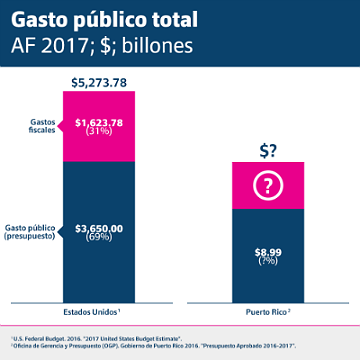
The United States government quantifies tax expenses in addition to the expenses included in the budget. This allows complete visibility on total public spending. On the other hand, in Puerto Rico we only have evidence of public spending included in the budget, but not of fiscal expenses. Therefore, we cannot know what the total public spending is.

Have studies been conducted on tax expenditures in Puerto Rico prior to the 2019 report? What do they recommend?

In 2014, KPMG consultancy published a report suggesting eliminating the majority of tax expenses for individuals and all tax expenses for corporations, which they calculated amounted to $556,054,582 (see Appendix B of the report). In the same year, the economist Ramón J. Cao García published an evaluation of tax incentives for companies in Puerto Rico. This report condemned the lack of statistical information and reiterated the overestimation of benefits and underestimation of costs as obstacles to an adequate evaluation of fiscal expenses.

Suscríbete

Recibe nuestras notificaciones

* requerido


¿Qué es EA?

Promovemos la transparencia y rendición de cuentas en los haberes públicos porque creemos que una sociedad más abierta, también será una más justa y equitativa.

Queremos saber dónde está nuestro dinero, qué se hace con nuestro dinero y quién decide sobre nuestro dinero, para provocar una mejor distribución de nuestros recursos y que el país completo pueda desarrollarse y avanzar.

¡Apóyanos!

Síguenos en:

Facebook
Twitter
YouTube
Instagram
  • Contáctanos
  • Sitemap
  • Política de privacidad
© 2025 Espacios Abiertos.