
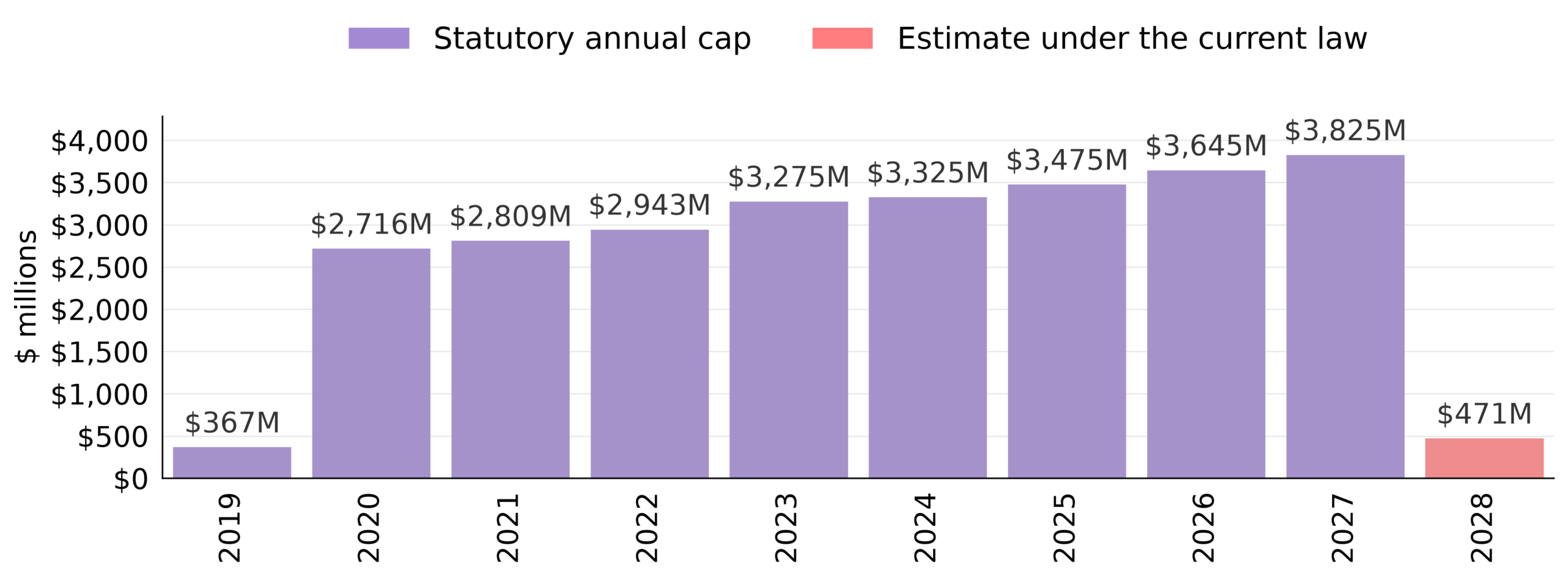
Puerto Rico’s Medicaid program is once again on the brink of a federal funding cliff. The current federal allocation is around $4 billion and is part of a five-year agreement that expires on September 30, 2027.
Absent legislative action by the U.S. Congress, the annual allocation would revert to its base levels, representing a reduction of close to 90% in federal contributions — or less than $500 million for the program in federal fiscal year 2028. The Federal Medical Assistance Percentage (FMAP), in turn, would also revert from 76% to 55%. Figures 1 and 2 show the possible levels of federal funding starting in federal fiscal year 2028 absent legislative action, compared with prior years and other jurisdictions.
Figure 1
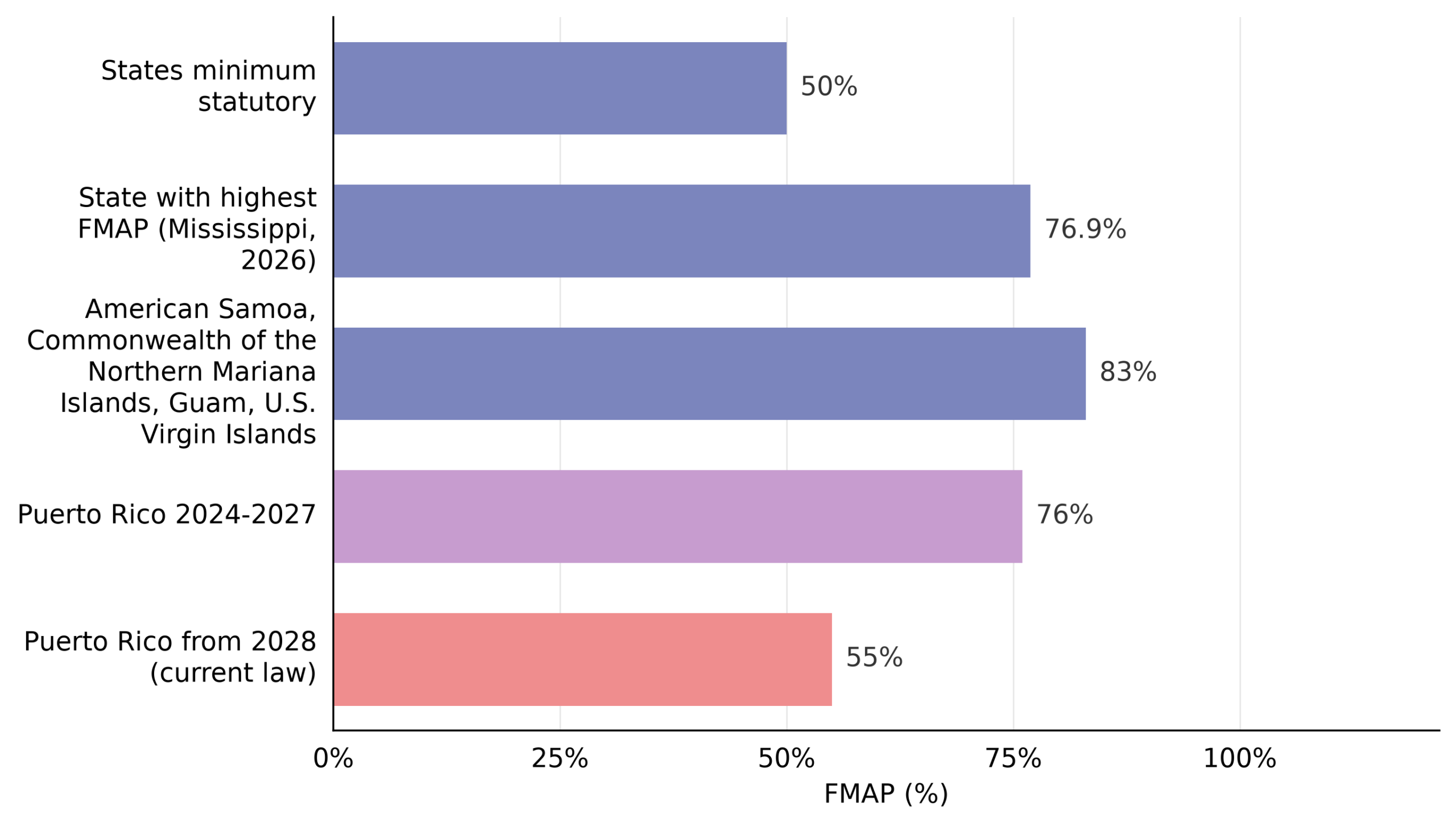
Figure 2
What Is Medicaid?
Medicaid is a federal program designed to provide medical care to certain populations in need. In Puerto Rico, the program funds Plan Vital, which provides medical coverage to a large share of the population (close to 40%) and has a direct impact both on the quality and availability of health services for beneficiaries as well as on Puerto Rico’s economy.
What’s Different About Medicaid in Puerto Rico?
Medicaid works differently in Puerto Rico than in the states. For the states, the federal government contributes to program spending through a match of federal and state funds. The level of federal contribution reaches a percentage based on each state’s per capita income, but it does not cap the total amount of funds allocated. This percentage is known as the FMAP.
Puerto Rico’s version of the program has two distinguishing features: 1) the federal matching percentage is fixed and does not adjust based on per capita income, and 2) the U.S. Congress determines the total amount of funds allocated to Puerto Rico in advance through an annual ceiling. As a result, the level of federal contribution is lower than what the matching percentage alone would produce, and much lower than what states receive. Other features of the program further limit Puerto Rico’s version of Medicaid: a different poverty line is used than in the states, the Government of Puerto Rico cannot provide all of the services required under Medicaid, and program spending grows at a faster pace on the Island than the adjustment to the annual ceiling.
How Has This Worked in the Past?
Uncertainty about the amount of federal funds allocated to Puerto Rico’s Medicaid program has been a constant. Historically, funding has not been sufficient to meet Puerto Rico’s needs. Although in recent years the Island has received a much larger federal contribution, that funding has been limited to short periods, with no guarantee that the level will hold in future years — preventing the Government of Puerto Rico from designing a sustainable Medicaid program that meets the population’s needs.
What Is Happening Now?
Once again, the future of federal Medicaid funding for Puerto Rico is uncertain. The amount of federal funds currently available is far larger than what Puerto Rico has received in the past, but it comes with an expiration date. Starting in federal fiscal year 2028, the amount allocated to the Island could fall by 90%, putting Puerto Rico’s Medicaid program, local finances, and access to medical care for a large share of the population at risk.
How Do We Know?
We conducted a sensitivity analysis to assess the possible impact of a change in federal contributions to Medicaid. A sensitivity analysis allows us to understand how sensitive one variable is to the effects of another variable over which we have no control. We use this analysis to understand the possible effect on Puerto Rico’s budget of a change in the level of federal funding, assuming that Medicaid spending on the Island keeps rising at a pace similar to prior years.
The analysis models three main scenarios:
- Scenario 1: Fiscal cliff, with an FMAP of 55% and an annual ceiling calculated from the federal fiscal year 2019 level.
- Scenario 2: Extension of current funding levels, with an FMAP of 76% and an annual ceiling calculated from the federal fiscal year 2027 level.
- Scenario 3: An increase similar to what the Government of Puerto Rico reportedly requested from the U.S. Congress, with an FMAP at the statutory maximum of 83% and an allocation of $4.415 billion for federal fiscal year 2028.
What Did We Find?
Our findings confirm that if Congress does not adopt legislation to maintain or expand the level of federal Medicaid funding, sustaining current coverage would have a fiscal impact on Puerto Rico of about $4.849 billion (Scenario 1). This figure is equivalent to 35.4% of the General Fund for fiscal year 2028, and contrasts dramatically with the estimate for the current fiscal year of 11.7% of the General Fund. Figure 3 presents the results of this analysis for all scenarios.
Figure 3
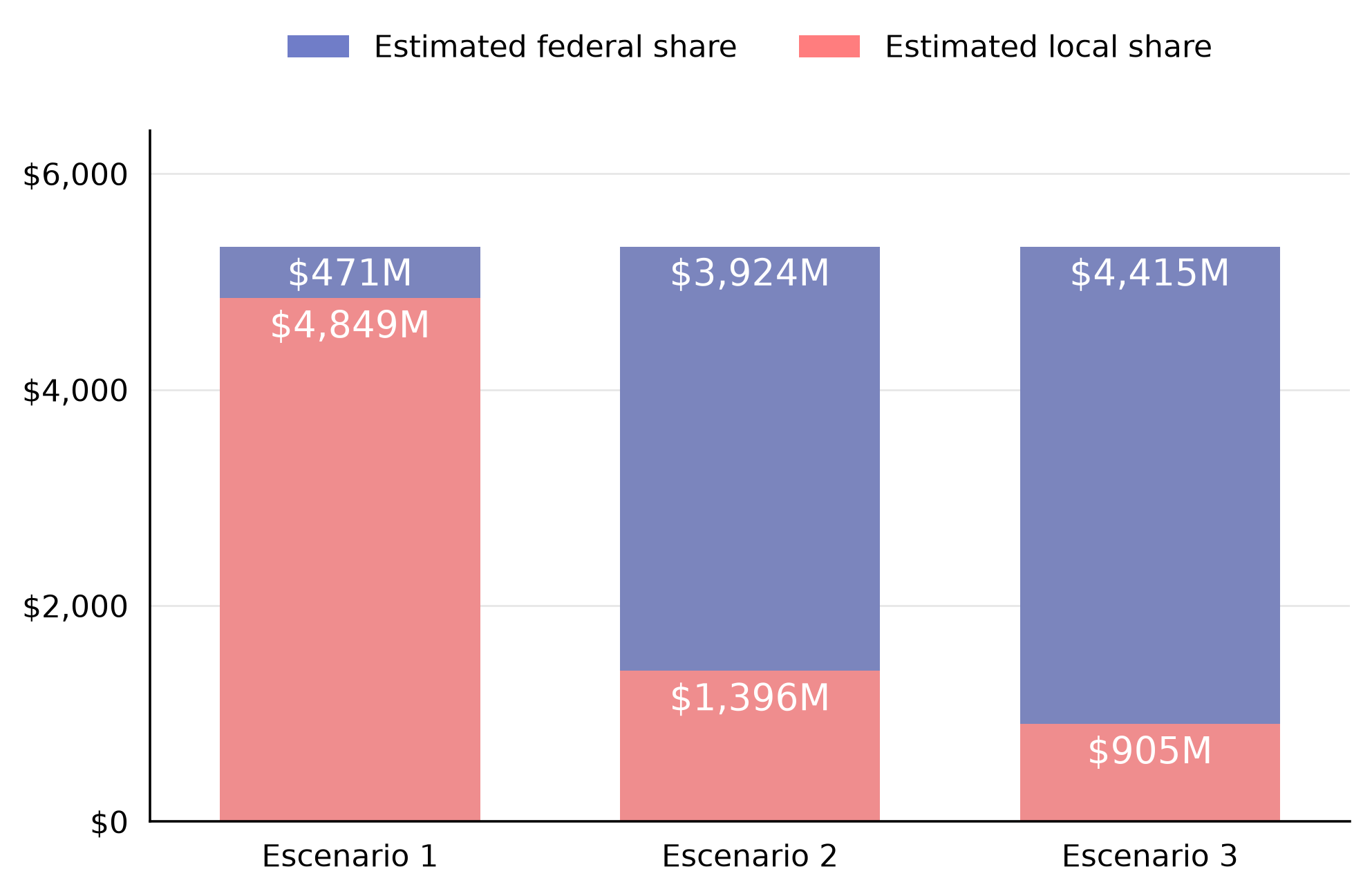
Meanwhile, a continuation of the current funding level, adjusted for inflation, would result in a moderate increase in the fiscal impact on the Island, reaching $1.396 billion, or 10.2% of the General Fund, for fiscal year 2028 (Scenario 2). Finally, a scenario in which the federal contribution represents 83% of estimated Medicaid spending, while maintaining the current level of coverage and services, results in an impact equivalent to 6.6% of the General Fund for fiscal year 2028 (Scenario 3).
In addition, we identified the following findings:
- Medicaid is the backbone of Puerto Rico’s health care system.
- Funding limitations have left Puerto Rico’s Medicaid program incomplete relative to the states.
- Medicaid funding in Puerto Rico is subject to significant disparities compared with the states.
- Funding has depended on temporary extensions rather than a permanent solution, and that pattern is about to repeat itself.
- Absent a permanent solution on par with the states, the funding gap will keep growing no matter how long the current level is extended.
- Without federal legislative action, the Government of Puerto Rico would have to cover up to $4.849 billion in local funds.
- A reduction in funding would put the medical coverage of between 700,000 and 1 million Puerto Ricans at risk, according to reports.
What Could This Mean?
A reduction in federal Medicaid contributions of the magnitude anticipated if the U.S. Congress fails to act would have catastrophic repercussions for Puerto Rico, affecting the entire population — particularly the most vulnerable, who depend on the program for their medical care. Faced with a Medicaid fiscal cliff, the Government of Puerto Rico would have very few options: reducing or eliminating spending in other programmatic areas, such as education, or scaling back Medicaid coverage, including eliminating services. Any such decision would be harmful to the people of Puerto Rico and would carry drastic fiscal consequences in the short and long term.
How Would This Be Resolved?
Any solution to this looming fiscal cliff that is not permanent, and not tied to Puerto Rico’s medical and fiscal realities, puts at risk the program’s effectiveness, the Island’s fiscal stability, and — more important still — the health of its beneficiaries. Our public policy recommendations for the U.S. Congress and the Government of Puerto Rico are aimed at addressing this situation:
To the U.S. Congress
- Eliminate the annual ceiling and set Puerto Rico’s FMAP using the formula applicable to the states (83%, with no ceiling).
- If a temporary extension is approved instead, it should include: a minimum term of five years, a ceiling indexed to actual Medicaid spending in Puerto Rico, correction of the base year, and funding for any new conditions imposed on the program.
To the Government of Puerto Rico, ASES, and the Departamento de Salud
- Adopt and publish a contingency plan for a possible reduction in federal funding, including its effect on municipalities.
- Publish the program’s financial information on a recurring, centralized basis, together with coverage and quality indicators.
- Estimate and publish the cost of achieving funding parity using the eligibility and coverage criteria applied in the states.
Read our report, “The Cost of Uncertainty Medicaid: Medicaid in Puerto Rico and the Gaps in Federal Funding,” for more detail.